|
|
RAMAKRISHNA VEDANTA VERENIGING NEDERLAND De Vlaschaard 57, 1183KM, Amstelveen 020-441-0155 vedanta.nederland@gmail.com |

| Swami Atulananda | |||||||
|
The first non-Indian monk of the Ramakrishna Order, from Amsterdam, The Netherlands.
Swami Atulananda's Pre-monastic Life
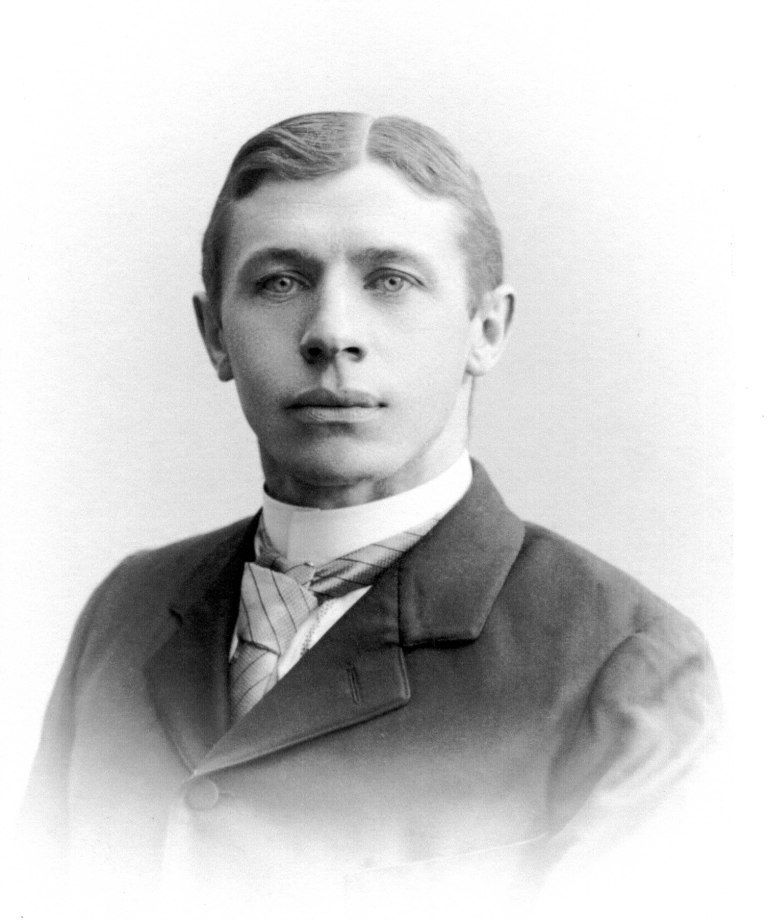
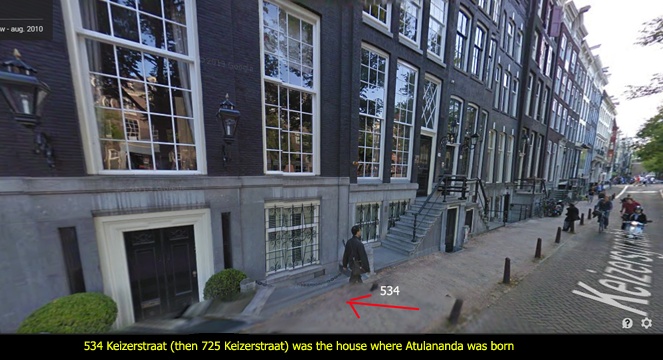
Cornelis Johannes Heijblom was born in Keizersgracht, Amsterdam, on the 7 February 1870. His parents were, Elisha William Heijblom (1831-1921), a wealthy stockbroker and broker, and Christina Jacoba van Oosterwijk Bruijn (1833-1881). In fact, all his ancestors were stockbrokers. Not much is known about Cornelis' childhood. When Cornelis was 11 years old, he lost his mother. Two years later, the family moved to Arnhem, where his father became a commissioner. Cornelis continued his studies there. In May 1892, his father remarried and the family moved to Velp.
Cornelis did not follow in the footsteps of his forefathers and so did not become a broker. He trained in agriculture. Those were terrible years for agriculturists in Europe. Thousands migrated to the United States owing to unemployment and poverty. It is not known why Cornelis moved over to the USA, but it is known that Providence had other plans for him. Boarding SS Veendam from Rotterdam on 24 October 1891, Cornelis reached New York on 4 November 1891. Thus, two years before Swami Vivekananda's arrival, Cornelis was in the USA.
Swami Atulananda and Vedanta Cornelis worked in various capacities in the USA, including working in farms for some time. A fall from the horse left him with a back injury, which was to trouble him all his life. He must have heard about Swami Vivekananda and his philosophy by 1894 because Swamiji was becoming well-known. Cornelis wanted to meet Swami Vivekananda. Meanwhile, Swamiji established the first-ever Vedanta Society in New York in 1894, and invited his brother-disciple, Swami Abhedananda, to work there. Meanwhile, Cornelis had read Swami Vivekananda’s Raja Yoga. He no doubt wanted to hear and meet Swami Vivekananda. One day, when he went to listen to the lecture of some American gentleman, a friend asked him if he would like to listen to Swami Vivekananda on a Sunday. Cornelis had thought Swami Vivekananda had returned to India, and he was right. Anyway, when he came to the venue of the talk and saw Swami Abhedananda instead of Swami Vivekananda, he was no doubt impressed by him too. Thus, Cornelis come to Vedanta in 1898 “accidentally”, as he states it in his book, With the Swamis in America and India. His first contact was with Swami Abhedananda, who ordained Cornelis into the vows of a novice (brahmacharin) and gave the name “Gurudas”. Since then, Gurudas worked intensely towards attaining the goal of spiritual illumination. He came into contact with a great illumined spiritual master, Swami Turiyananda, who had come to the United States from India to assist Swami Vivekananda in his work. Gurudas worked intensely alongside others to build up the huge retreat of 160 acres, Shanti Ashrama, in San Antonio Valley, California, which continues to inspire everyone even today. His close contact with Swami Turiyananda for years made him even more ardent in his search for Truth. Before his passing, Swami Turiyananda told Gurudas: “My boy," he said, "I have given you the very best that India has to give; it is a great treasure, keep it carefully."
|
THE VISION OF THE HIGHEST
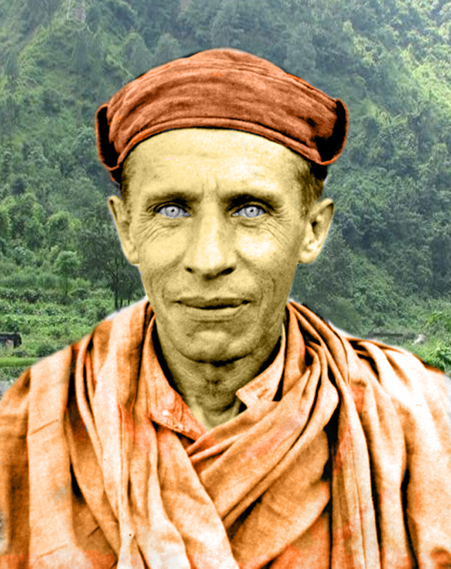
It was March 15, 1958. A venerable 88-year old monk was talking privately to a few younger brother monks about his spiritual experiences. He was telling them he once vividly experienced that he was divine and separate from the world. The world then appeared to him like a huge ball full of moving creatures, and he felt that he had no connection whatsoever with it. He said, “I am divine; that is perceived on a certain plane of consciousness. In the normal plane, however, I am here; these things are real, as dream objects appear to be real in the dream state.” Again on March 16th he talked to his brother monks about the same experience: “When I experienced that the world, with all moving creatures was entirely separate from me, like a ball, or like the planet Mars in the sky, I had no body consciousness and I felt that I had no connection whatsoever with this world—neither had I any connection with it in the past, nor have I now, nor will I have in the future. And I found others also to be contained in the divine Atman, and thought: ‘If only these people could know about it!’ I found no desire in me—complete desirelessness. But still I had the idea of many Âtmans (Selves). I didn’t have the idea of Oneness, One in all.” Then, he continued: “Swami Turiyananda once told me: ‘First one has to know oneself; then one can know others to be the same.’ Illumination comes suddenly, quickly. How and when, it cannot be said. When I learned bicycling, at first I couldn’t maintain my balance. The teacher told me, ‘Don’t look at the wheel; look straight ahead.’ Then suddenly it was all right. So you see, a teacher is needed. The knack comes suddenly.” Decades of Austerities in India Swami Atulananda met Swami Vivekananda and received his blessings. He travelled to India and the most blessed moment of his life came when, in 1911, he received spiritual initiation from none other than Holy Mother Sri Sarada Devi. In 1923, Gurudas Maharaj received monastic vows, sannyasa, and became Swami Atulananda. He is the first-ever non-Indian monk of the Ramakrishna Order to have lived the whole life as a monk. Atulananda came in close contact with all the sixteen direct disciples of Sri Ramakrishna. An inspiring life all through, Atulananda never murmured when the harsh Indian climate tested him severely as did the other troubles. He bore all difficulties silently and never complained about his health problems, though they caused immense trouble to him.
Atulananda was an illumined soul. A notable incident in his life, when he came face to face with God, is narrated in one of his books. "Swami Prabhavananda and I went on pilgrimage to Kedarnath and Badrinarayan. Being a "European", at Kedarnath I was not allowed to enter the temple. I was disappointed. We reached Badrinarayan in the evening. After washing in the hot spring, we, together with many other pilgrims, waited in front of the temple door in expectation of darshan (the blessing of seeing the image, often termed diety.) Suddenly a priest opened the temple door, beckoned to me alone, took me inside the temple, and closed the door. I was shown everything--the holy of holies, the deity. I came out satisfied. Afterwards I did not see the priest anymore. In the late evening the director of the temple sent a man to us bearing the message that he had heard that an American swami had come and hoped to have the darshan of the deity. But as it was against the rules to allow a foreigner inside the temple, arrangements would be made so that the swami could see the deity from outside. The door was opened, people were made to stand aside, and a light was shone on the deity, thus allowing me to have darshan from outside. "We came back by way of Almora. Swami Turiyananda was staying there. When he heard about the incident, he said, 'You know, it was Thakur who appeared as the young priest to take you inside the temple.... I don't disbelieve it. The Lord plays in many ways. Nothing is impossible for Him.' There are several books connected with Swami Atulananda, of which With the Swamis in America and India and Atman Alone Abides are important. Read the first book here: With the Swamis in America and India. Swami Atulananda lived at the foot of the Himalayas, in Rishikesh, for many years. He also lived in Missouri, constantly in His contemplation. He gave up his body on 10 August 1966, at the ripe age of 96 years.
|
||||||
|
|||||||